

A different perspective on small wrongs we do each other
Generative conflict, holding ambivalence, narrative complexity, and repair

If your relationships are flattening into people who get it and people who don’t…this is pretty normal.
As cortisol remains elevated from chronic stress, nuance collapses. And for as many “we protect us” shields we see in pictures, it seems few are equipped with tools to navigate relational conflict, ambivalence, repair.
This essay suggests play and playing friends can help.
Capitalist realism
The fiction we live is thoroughly convincing.
A couple weeks ago, I implemented established organizer tips around game nights and play as foundational to sustained cohesion. Over a dozen people signed up. This is Los Angeles though so, on the day, most canceled.
When someone says “it is what it is” about missing game night for work, they're not wrong—the system is thoroughly convincing. Stuckness in cubicles of our own making is a natural by-product of what Mark Fisher might call capitalist realism: the naturalization of economic systems of control.
His book of the same name begins: “It’s easier to imagine the end of the world than the end of capitalism.” And with the recent release of more Epstein files, including all the ties to billionaire money and information control, it’s easy to see why critical creativity is so incredibly hard.
This is why I align imaginative play with activism, with generative world-building, with dignity. We cannot build what we cannot imagine. To play mindfully stays with the present moment, where we remain fully embodied in our human nature to grow old, get sick, and die. Its sincerity of presence is kindness.
But I mean actually playing, not gaming, not spectating. The distinction matters in an era of “actual play” content to consume. That genre of entertainment is popular because for adults, actually playing can feel like the harder work.
When homework is worth it
Open-ended imaginative play—the kind without oracles or clear win-states—can feel like “homework,” cognitive labor handed to a student.
As is, the tired hippocampus “helps” by telling us stereotypes are right, details are unnecessary, that we can probably read minds, and the bad thing will happen again. This makes relying on patterns easier, even when they don't serve us.
It's why your relationships may be flattening and why playing with identity and relationships can be helpful.
In a systemic review of drama therapy1—agential, embodied, storytelling—psychologist Tobias Constien’s team found all 20 studies showed play has significant outcomes for traumatized and marginalized participants.
More specifically,
16 studies “described clients’ experiences of finding commonality and asserting agency within and beyond the social microcosm”
13 studies showed play encouraged “unexpected access” to emotional regulation
13 studies helped 30+ participants “develop new perspectives on their current circumstances or past experiences”
12 studies left 40+ participants “empowered to share and reclaim their life stories” after play
11 studies gave “renewed confidence [that] translated into participants taking on an active role in therapy and in life” (original emphasis)
Free play provides consistent benefits we need across scales and domains. This is why play is so often prescribed alongside things like meditation. It is free and freely available. We just have become so alienated it’s hard to remember we have choice.
I launched the Creative Coalition as structured practice to reclaim what’s being systematically drained: our ability to see the waters we swim in, even if just for a moment, and choose our response.
Offering a space to practice “mindful play” can look a lot like the entertainment I critiqued above. One difference, for me: presence is more important than the product. Emergent meaning making always matters more than anticipated outcome. The people at the table matter more than the game.
And this month, the game is all about the people.
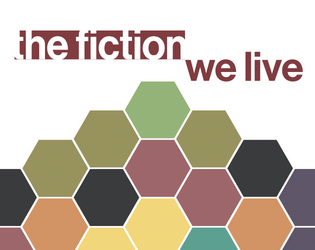
A Relationship Crawl
Nightmare fuel Excellent practice for holding that my memory is true AND your different memory is also true AND neither of us is lying.
Chris Bissette describes The Fiction We Live as “a storytelling game about friendship, shared history, and the small wrongs we do each other over time.” Players create their own character, their relationship histories, and why they are gathered in the present.
The “controlling player” rolls a single six-sided die to determine their direction on a hex-map. The cells on the map provide context for memory: bonding and anger, happy memories and catastrophe, sex and romance. They then narrate a scene from the past along those lines like, for example, a memory of resentment.
And here’s why I chose the game: it explicitly invites different voices and perspectives into those scenes. “I have a different perspective on that” allows players to chime in with new details, forgotten aspects, things the character might have forgotten or omitted in the re-telling.
Bleed occurs when the game begins to inform real-life. While bleed happens at the site of embodied experience, it illuminates systems operations. When the game and the play environment allows us to see everyday structures more critically, we can move through both with more agency.
As such, this game elegantly sets up practice with
Generative conflict: coming into a better understanding of oneself and relationships through conversation
Tending ambivalence: After all, the friends have willingly re-gathered again in the present, despite whatever happened in the past.
Repair capacity: the characters have gathered, and remain gathered. The players themselves rehearse sandboxed conflict, and debrief after.
These are skills that can atrophy or strengthen with practice. So might as well practice in a sandbox.
But just as we entered this political moment with embodied histories, we enter play with interpersonal ones. Bissette ends the game with this reminder:
Remember that this was just a game. If things got a little real, you may want to talk about that — or you may want to step away and give yourselves some space. Remember that the game is never more important than the people playing it. Take care of each other during play and afterwards.
I won’t prompt you to imagine a world where we can play, discuss past harms, and care for each other after.
It is what it is: an invitation.
Creative Coalition: The Fiction We Live — February 21
Come play.
The Creative Coalition is an online forum that serves people who believe in the power of making belief.
We are more dynamic than most meditative practices, more grounded than a typical game night. We begin with a meditation and intention-setting, review how to play, discuss trust and safety, play, enjoy a screen break, and debrief about what arose.
Note: The game includes prompts for scenes involving sex and romance. What this means is determined when we discuss trust and safety agreements on the day.
This game lends itself to intentions around speech, listening, and emotional reactivity, along with the usual ones of giving oneself grace and space to imagine in the first place.
February 21, 1-5:00 PM PT
Duration varies based on number of players. While I sincerely doubt this will take four full hours, please allocate time if you intend to come.
Limit 5
Base price: $120
Due to the hiatus, paid subscribers ($80/year) join free this month (and get steep discounts on future events).
No scholarships this round (again due to hiatus). Expect their return next month.
👥 Sign up here!
Thank you for reading. If you liked this (hit the heart!), consider checking out


Constien, Tobias, Akhila Khanna, and Amélie Wiberg. “Client Experiences of Drama Therapy: A Systematic Review and Qualitative Meta-Analysis.” Qualitative Psychology, 2024. ProQuest, https://www.proquest.com/scholarly-journals/client-experiences-drama-therapy-systematic/docview/3108366453/se-2, doi:https://doi.org/10.1037/qup0000300.
And I’m grateful for this one, too (catching up on the past couple posts). Excited for the play! Thanks for what you invite us to, Logan. It’s life-giving and world-making.