

practicing liberation, prioritizing play
rolling for initiative

Two weeks ago, I dreamed of a world where people could befriend their bodies and emotions, enough to feel them and not be taken over. Small groups gathered around tables for dialogue about the worlds they want. And then last week.
As individuals in a changing climate, we have very little control. As individuals in a “democratic republic,” it’s clear we have little control over someone who says a giant landmass is necessary to his personal “psychology.” We live in a state willing to shoot someone four times, then berate her, then deny her medical care, and then lie about it.
Our power must be multiple, responsive, and agile. And to organize it, I believe we begin small. Me and you and the relationships we build are the most direct of actions.
Last week, I kept asking myself: Can sitting, sharing, witnessing each other be enough? This week, I’ll respond with a “yes, but”: not if it requires you to abandon yourself.
Light Hive offers embodied and engaged relational practices amid collapse. Subscribe for dharma-inspired essays from a queer, transracial adoptee.
Practicing liberation
The need for small group dialogue is not a personal preference.
During the Civil Rights Movement, people like Georgia Gilmore turned her kitchen into a hive of change: people gathered around her table, set with sweet potato pie, fried fish, and stewed greens, to banter and strategize.
Caregiving as social justice, meanwhile, has several lineages. Here, I’ll name the work of intersectional feminists within the disability rights movement like Leah Lakshmi Piepzna-Samarasinha and Mia Mingus. But whether it’s the consciousness-raising groups of the 1970s or your mutual aid pod, these small groups are, themselves, the movement.
Therefore, it’s helpful to learn from the past and implement now, as conditions tighten.
In Practicing Liberation, Tessa Hicks Peterson and Hala Khouri asked a collective of almost two dozen seasoned organizers what would ensure their movement didn’t recreate the violence they were fighting against. (I’ve re-ordered the bullet points to match the order that follows.)
Prioritizing […] time and value to expressing candidly vulnerability around hardships in the work, feedback for how support can be given and received, setting boundaries clearly, upholding accountability, utilizing power intentionally in horizontal instead of hierarchical manners (i.e., power with/to/within rather than over), and regularly engaging in rest, play, and repair
Embedding trauma-informed, healing-centered frameworks and practices in the structure, policy, values, and culture […]
Facilitating routine listening circles, [… and] community-building practices to build trust and feel connected within and across the community
Regularly reflecting on whether these policies and practices are making a difference to well-being and sustainability in the work
With this lived wisdom in mind, I set out to address the events of last week.
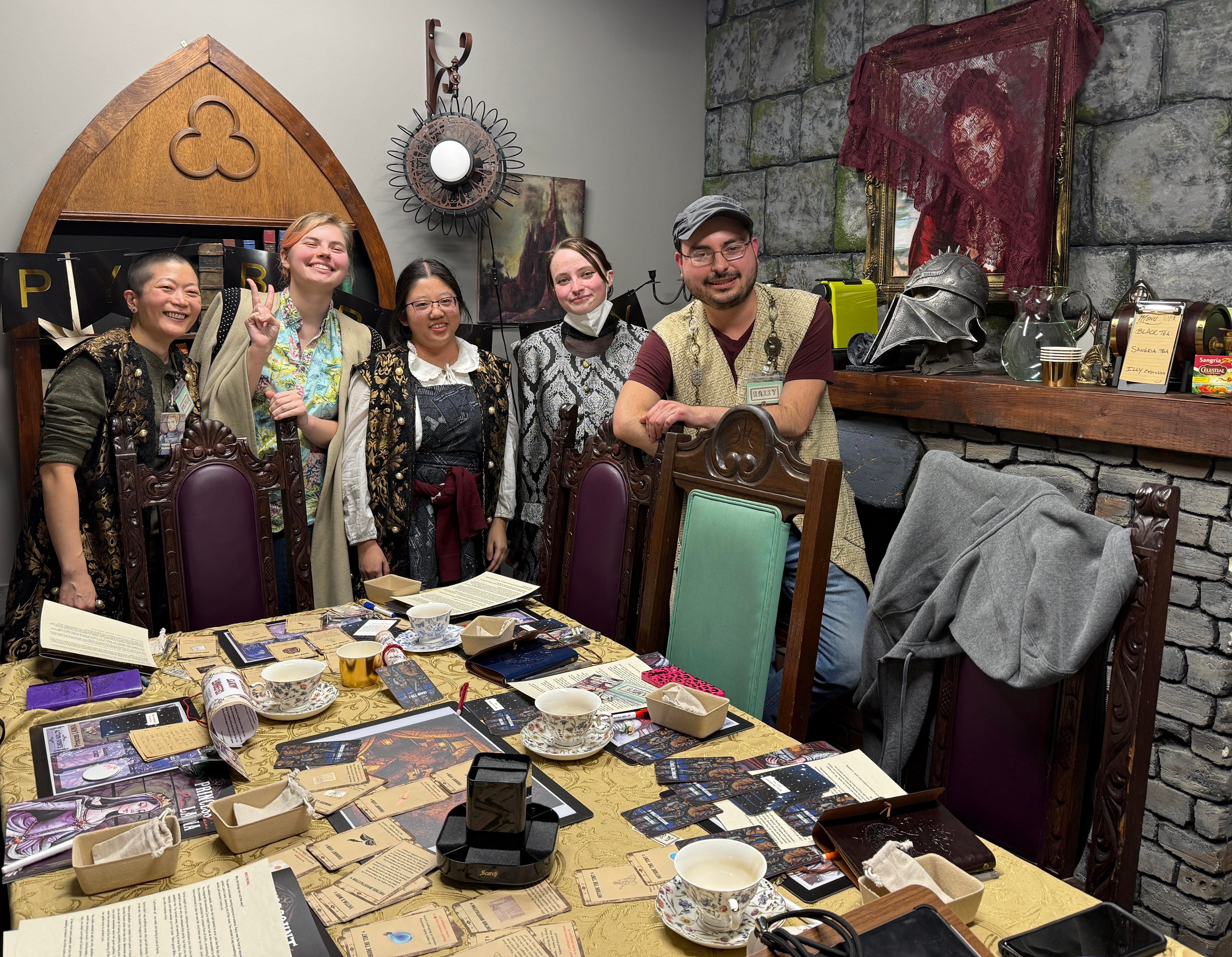
Prioritizing play
We need lateral connections to build strong ties.
On Tuesday, I played Jubensha, a murder mystery wrapped in a murder mystery table-top live action role playing game. This game is huge in China right now, and I can see why. Viscount Donne was plagiarized! Justice for the Viscount/Sylvia! HIGHLY RECOMMENDED, READERS!
As soon as I got home, I announced I would be starting a monthly board game group. I chose board games rather than the emergent storytelling games I’ve run for my Creative Coalition, because these provide clear rules, mechanics, and win-states. There are actual answers. Structure makes the discourse-avoidant less anxious to share.
Someone asked: Why?
They clearly had not read my treatise on mindful play, so I gave this response:
It’s an opportunity for lateral coalition building, internal cohesion, and having a decent time moving our minds differently together.
(AKA: Let’s get some dialogue up in here, for real, yo. I don’t even care what it looks like, we need to TALK.)
Embedding trauma-informed structure
How much humiliation is permissible in your groups?
A few weeks ago, I wrote about centered accountability, vulnerability, and courage. I provided a case study about pronouns. It took this quote from Richard Seymour’s Disaster Nationalism to tip me over.
The obsession with seemingly trivial expressive norms, such as the use of correct gender pronouns, is in fact fundamentally about how much violence and humiliation are socially permissible.
Two weeks ago, I found out the person who could not respect my pronouns blocked me. We share several groups and so this hindered my ability to communicate on our shared platform.
I’d invited mediation from the leader of an organizing group. They didn’t need to mess with the pronouns. I just want equal access and opportunity to contribute. Alas, the person who would not honor my pronouns also would not engage in mediation.
Feeling like a second-class citizen in your own group seems a bit extra for the times we’re in. When I left, no one—including the would-be mediator—asked why. Their silence and inaction was useful information. Moving swiftly on.
Practice as policy
Necessary infrastructure, not a deficiency.
It is known that caregivers and trauma stewards need their own caregivers and trauma stewards. Therapists have their own therapists. Chaplains have their own chaplains.
I’ve always told my students that if they cannot share what’s arising for them in the spaces they lead, they are not leading inclusive spaces. And in mutual aid set-ups, care and communication protocols are constantly evolving. This gives more reason to establish a baseline to discuss as-needed adjustments.
And so after announcing a game night, my second action was to build internal support. I found someone with nonviolent communication skills who agreed to help me and alternate facilitation. We would debrief alongside each other.
The third thing was to get a clear affirmative on whether the current admins would support me with specific help: chat moderation, advisory for the group, and substitute facilitation. One agreed “for now.” Solid. I’ll take that over the nothing I had before.
The other communicated concern about my stress levels.
I found this a non sequitur, so I followed up in a direct message: I’m asking for as-needed help because “No” is acceptable. Can you please give a yes or no?
I got an “affirmative” and a salute emoji…a “yes” in one sense, a “no” in another.
Listening to build trust
Accountability is ownership of one’s role in a dynamic, not order and obedience.
I believe asking for help is strength, not a sign of distress. When the group responds to requests for help with “concern” about your personal stress levels in 2026: assess alignment.
The interpersonal identity politics of “before Trump 2.0” persist today. I’ll defer to Kelly Hayes and Mariame Kaba’s Let This Radicalize You:
Many Black, Indigenous, and women and trans people of color also experience what [disability activist] Leah Lakshmi Piepzna-Samarasinha has termed “hyper-accountability,” where, in addition to performing a disproportionate amount of labor for a cause, a person (usually a marginalized person) is expected to respond immediately and flawlessly to any and all claims that their work or behavior is somehow lacking or problematic.
Accountability is dialogic. You cannot be accountable to each other if you cannot name needs, wants, and boundaries without being told to check yourself.
Centered accountability is karma.
Regular reflection on what works
Collective issues deserve a collective response.
My practice has always been to connect the individual and systemic. Our bodies are our worlds. We are inseparable, interdependent, interbeings. We can learn so much about the world if we pay enough attention to the intricacies of experience.
And we can learn by letting go of the preconceived stories about how the world works, to just experience real-time.
In All About Love, Buddhist practitioner and general badass bell hooks writes about the integrity needed to live a spiritual life.
A commitment to a spiritual life requires us to do more than read a good book or go on a restful retreat. It requires conscious practice, a willingness to unite the way we think with the way we act.
Two weeks ago I wrote about empire within justice coalitions. Unless your group is actively working against these tendencies, it’s likely to perpetuate exclusion, hierarchy, and capitalist ideals. Last week was my lived articulation.
This week: a resolute pit stop. I created community events, built trauma-informed structure, attempted interpersonal repair and set up both a pivot and an exit ramp. If we can dialogue, I believe we will be stronger for it. If we cannot, they are welcome to follow. If they don’t want to, I have set up conditions for continued support.
In the end, friends, there’s so much I don’t know. Who knows anything anymore?!
So let me tell you what I believe.
Faith and justice are embodied practices. You do not need to be perfect. You do not need to always be “on.” The task is to unite the way you think, the values you hold, and the way you act.
Respect and mutual aid is what makes a community.
And you know what? The group was super into me talking about my friend cards. I’m going to be setting up the infrastructure to use them. I’m stoked.
I can’t imagine a time I will not advocate for small group cohesion. This is because groups form through gathered intention and action within and among ourselves.
This isn’t just a platitude, not just a book. Intention, action, faith, justice, and so much more, can be all about love.
Thank you for reading. If you liked this (hit the heart!), consider checking out


It seems to me like “interpersonal practices” are essential for activists (and all of us, and also, activists!). We have to be practicing in our own circles the way we want the wider worlds to live. I’m not finding today where you posted the part about being told you did not take enough responsibility for yourself, but have been reflecting on that and want to say more.
I just... I don't want to hijack the whole thread, but I'll suffice it to say that I've been working in my community for over 20 years, and in recent years, particularly since Covid, the local "activist" scene and all the small groups therein have become just insanely toxic. They automatically essentially find a way to attack or demean any and all newcomers (and some community "veterans"), so now people simply don't go to any kind of community organizing events. We recently had a meeting to discuss how to prepare for an ICE invasion, which seems to be coming our way fairly soon, and out of a region with 1.8M people, there were 30 people in the room. I believe that's a direct result of the past five years of just rabidly toxic environment throughout the "organizing" and "activist" community here. The leaders within that community still complain that "no one is coming out" and they don't have enough volunteers, workers, etc. and yet they inevitably find a way to attack every single person who does come out. It would be almost amusing if it wasn't such a dire situation and carry such tragic consequences for everyone in our region, especially the immigrant community which has no protection in place. There is no organized ICE watch here, all because the people who could and should be organizing that are in a room bickering with each other and anyone who comes near. There are no parallel systems of support because toxic people are gatekeeping that community.
Some of us have decided to just start from scratch, start having meetings elsewhere, and establishing a sort of parallel community of organizers and activists who actually do welcome all and provide tangible ways to plug in and help, even though there will inevitably be backlash from that core toxic group of community "organizers" as they will presumably screech about "recreating the wheel" and "duplicating efforts" but.... their "efforts" are producing NOTHING of tangible value to our community!