

When crisis calls for play
What the Hack Can't Take and AI Can't Fake

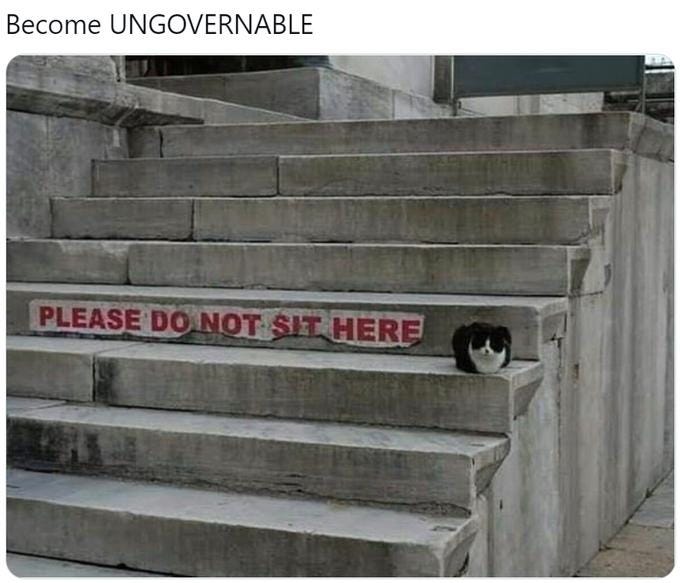
One night during my first year of college, the power went out across campus. We were all excited at the novelty of walking around in the dark. Some guy played his guitar. Getting high and singing Green Day probably wasn’t “wise” or “right” or “skillful,” but we did it anyway. And it was great.
Now, we are living through a version of the power going out on a much larger scale. If you’re like me, the headlines are as fleeting as your own embodied presence.
After my recent mindful play workshop, someone who works on STEM pedagogy wanted to know something along the lines of
How do you build a curiosity-driven container with everything [waves hands] going on?
Well, let’s orient toward some of the hand-waving.
What the hack can’t take
The stuff that wasn’t uploaded in the first place.
At my departmental meeting a couple weeks ago, we were reminded to revise all uploaded materials on our learning management system, Canvas. Everything needs to be more OCR-friendly—legible to scanning software—ASAP for accessibility purposes.
Since 2025, Canvas’ parent company Instructure has had a partnership with OpenAI. This means students can have “rich, casual, interactive conversations in a ChatGPT-like environment,” and that there would be a documented message trail, showing “evidence of learning.”
This week, ShinyHunters hacked Instructure and schools around the world had ransom notes posted on their sites. More than 275 million records were taken—approximately 3.65 terabytes of (at least) metadata, inclusive of all conversations held on the platform between instructors, students, and their AI assignments.
Accessibility indeed. The supreme court just rolled back data privacy, allowing data brokers to sell metadata (like the kind stolen from the LMS we are required to use) “to predict and manipulate your behavior, including what you buy, feel, think and do.”
This is the system we're optimizing for.
It’s also the system some STEM instructors hope to change. STEM students are conditioned to one that “teaches to exclude,” and drives roughly half of STEM students out of their majors before graduation. Research links the persistent mastery-based grading to elevated rates of anxiety, depression, perfectionism, and imposter syndrome. The latter is very real and has significant consequences beyond the university classroom.
In 2018, I worked on a study on women in STEM professions. Despite being much more represented in higher education, female graduates rarely went into professional fields related to their major. While my co-authored study advocated for more diverse media representation of intersectional women in leadership positions, the STEM educator’s strategy included role-play.
They spoke of a situation wherein students were asked to respond “as a scientist.” As a scientist, I’d…. Saying “I am a scientist” in a low-stakes setting, repeatedly, eventually lands. “I am a scientist.”
Friends, as you might imagine, this conversation felt like the most glorious mind meld ever.
If a science educator is advocating for self-identification and relational work as valid metrics of success, I don’t think us in the humanities and social sciences need to become more legible to AI.
We need to remember who we are without it.
Zero rejection
Lightning fast precision seems like the dream.
The studies look good on paper. Students report higher motivation when they use AI. One study found that 78% of students reported increased motivation through AI tools, and 70% of students feel more comfortable participating in class when they could do so through AI intermediaries rather than directly with the people in the room.
Again: studies used to promote AI in education are using reasons like “they’re more comfortable not talking to people.” I can’t separate these stats from similar psychosocial metrics, like how more than half of teen boys (58%) in one study are opting for AI girlfriends for “maximum control, zero rejection.”
But when your AI teacher is also your AI girlfriend is also indistinguishable from your “actual” intelligence, the messiness of real relationship feels like a malfunction.
There is a clear and broad need to practice the vulnerability of not knowing, the discomfort of exposure, the sting of correction. And I think it’s done through actual relationship.
I'm required to use Canvas and make my materials blanketly "accessible.” I will, of course, eventually, do this. It won’t be hard to comply, since most of my teaching doesn't live in the system anyway. It in the gathering.
Make the best of this test
It’s not a question but a lesson learned in time.
I’m a queer AFAB of color teaching required courses. Every quarter, I stand in front of a room of strangers who didn’t choose me or my class.
This was part of my response when asked how I learned to build a container among complete strangers as witnessed in the workshop. I show up and invite them into a mutual relationship as if, like the MLK quote goes, we are tied in a single garment of destiny.
Just like a game system, a legal system, an economic system: the rubric is always and never the point. It’s always the rubric insofar as this is a university setting—students want to know how they’ll be assessed. We are gathered to aim for the learning objectives as stated on the syllabus. This is the agreement.
At the same time, it’s never the rubric. What matters is we are gathered and present. This informs my syllabus, the way I run peer review, the group agreements I ask them to discuss, and the intentions and self-reflections I ask of them.
This quarter, I’m teaching a required class called “business and social policy.” It’s largely in-class writing and games for senior business and economics majors, many literally leaving the last week of class for their Manhattan investment banking gigs.
A survey I conducted prior to the mindful play workshop suggests it’s working in both the motivation and relational ways I intend.
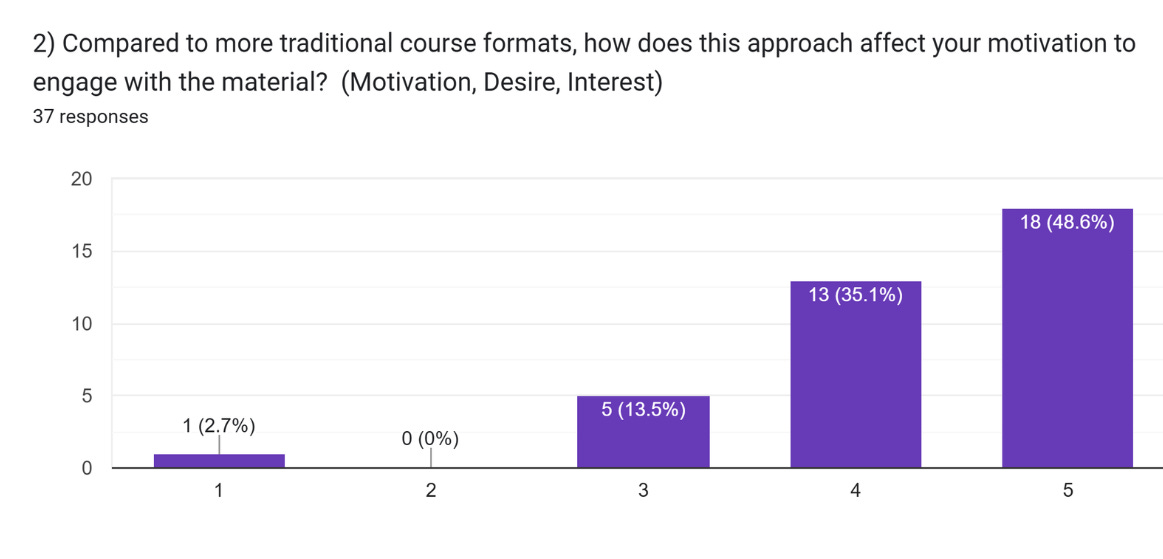
The survey produced this piece of feedback: “it’s fun [...] learning how to be a better communicator and a better person.”
“Thank you for seeing us not just as students but as people with worries.”
These times will keep asking a great deal of us. Data centers go up, even when they’re voted down. Through catastrophic emissions and stolen water, technologies that assert themselves as the future steal exactly that. We know the strain on the power grid in a normal summer and can only imagine one in a “monster El Niño.”
The power might not ever come “back on” in the same way. Maybe you don’t have a guy with a guitar on hand.
It’s something unpredictable, but in the end is right
I hope you have the time of your life
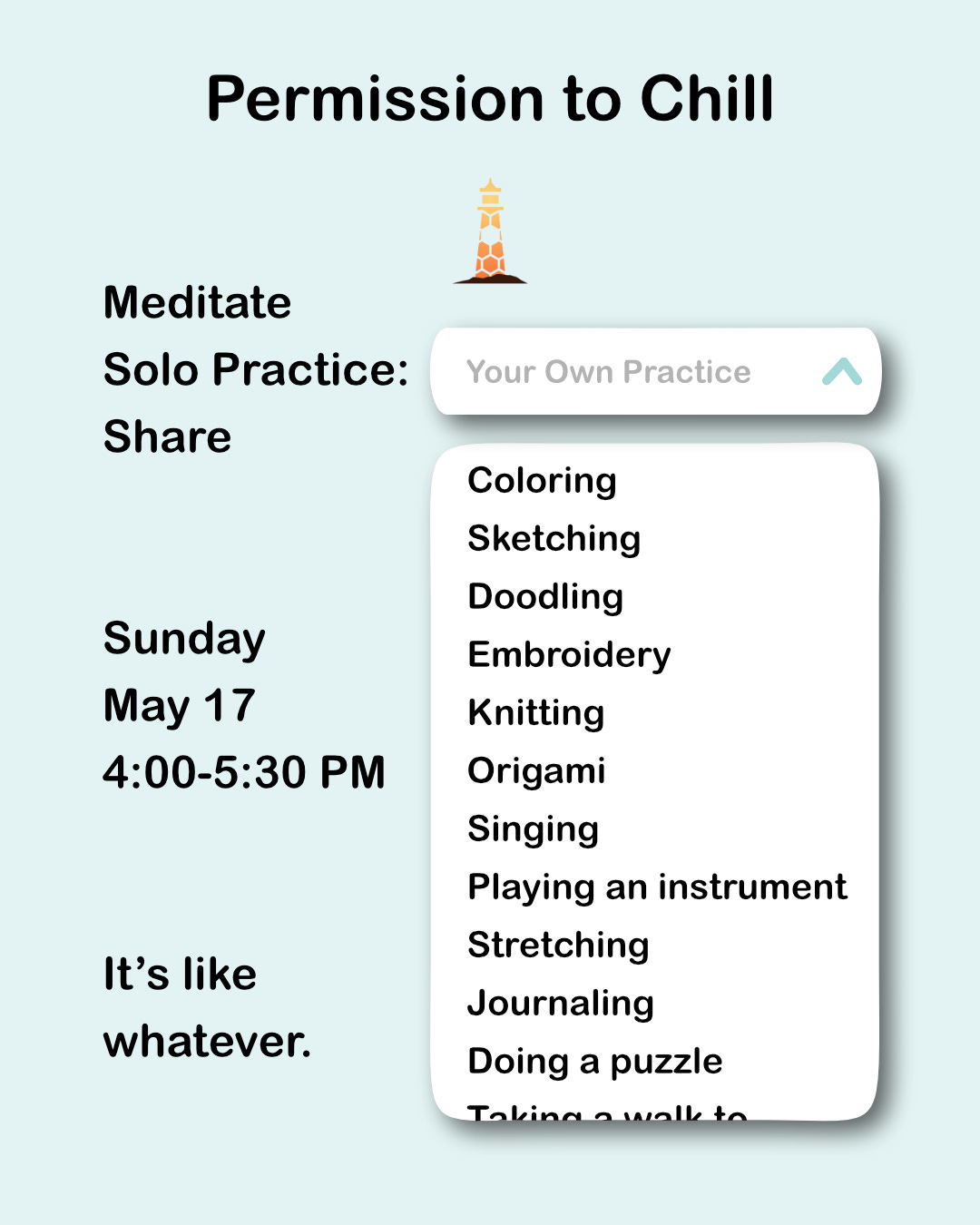
This Sunday, I’m offering a 90-minute session from 4:00-5:30 PM pacific time We’ll meditate for a bit on themes from this month, then announce what we’ll be doing in the solo practice period. This ~30-minute block is dedicated to doing something we enjoy but keep not doing. Then, we’ll come back together to discuss: Did you do it? did you enjoy it? How do you feel now?
No registration required, but I will ask for cams to be on at least in the beginning.
Thank you for reading. If you liked this (hit the heart!), check out:


I missed your permission to chill event! Do you have any play sessions /workshops planned for the summer? I need to do a better job staying up to date on your writing so I don't miss it! (not the only reason I want to stay up to date on your writing of course, but one of them!)
The increasingly reliance on AI makes me worried for our future. Also saying and thinking that makes me feel 10,000 years old and like I have a tin foil hat on. But seeing the amount that high school students are using it to think rather than support is worrisome. The thought that we would also accept as a society using AI for emotional detachment from society is terrifying. It certainly won’t help the “male loneliness epidemic” and inter-gender relationships.