

That time I was German
Anytown and Attunement


When I was in eighth grade, I attended a camp called Anytown USA. This multi-night woodland experience in Northern Arizona taught us “leaders” (8th grade flex) about diversity.
Anytown gave me my first structured interfacing with being transracially adopted. Midway through, we were divided into backgrounds. We aren’t allowed to talk to any other group. We would be, as much as possible, segregated.
Am I Korean enough to sit with the Koreans? My adoptive mom’s side was German and my Dad’s side was Polish/Italian. My last name sounds Italian. Am I Italian?
I asked an adult where I go. I don’t remember the interaction, only that no one answered my question for me.
The group of us Germans was small. I remember asking if pickles were German. No one knew. We pretty much only knew about the Holocaust. Awkward.
I remember spending a lot of time sitting on a rock near a creek, alone. It was nice.
The exercise culminated, as I imagine it usually does, when the popular kids decided it was over, and everybody began hugging each other. Diane Serrano and Saleemah Knight ran to each other in the middle of the camp courtyard, crying at their own affective realizations around difference.
Summoned by the commotion from my rock, I looked over at my fellow Germans, relieved we didn’t need to pretend to know about Germany anymore.
25 years after Anytown, I’d be talking about being transracially adopted in a Sutta study group.
“Her people”
While I’ve forgotten the topic of the study group, I won’t soon forget the break-out room discussion.
I shared a desire to run groups for transracial adoptees. I was moving from focused study on primal wounds—the neurological and interpersonal impacts of being separated at birth and placed in institutional “care” for extended periods of time—to one on death and making the life leading up to it meaningful.
One of the other participants happened to be an adoptive mother (white) of a transracial black woman. She said her daughter should talk to me, because she struggles to feel joy.
I asked when she adopted her daughter: in the 1990s. I asked if the daughter had any black adults in her life growing up.
No, why? She had a loving and supportive (white) family. They celebrated holidays. She (a white woman) even learned how to care for (black) daughter’s hair.
The woman’s computer set-up was against the wall in what seemed to be a very large, sparsely furnished living area with white marble tile floors. Behind the mother’s left shoulder one or two steps led to another large seemingly vacant area.
What a lonely, almost hollow, place. Of course her daughter struggled with joy.
“She gets so angry when I tell her that her people are naturally good dancers.”
Ah yes. The kind she didn't have relationships with growing up.
I do not believe this mother intended to come to a Buddhist study group to showcase prejudice against her daughter. But the third discussant (white, trans) was over it.
“You need to stop talking.”
The mother began to defend herself. She did not seem practiced in receiving frustration. I wondered how many of the daughter’s words never echoed around that marble, because they were never spoken, because she was never heard.
“No. Listen to yourself. You should be ashamed. You need to not speak.” They included a specific sound and gesture that made me think of Dr. Evil. Sh! Zip!
The mother, and any opportunity for dialogue, left the call.
Ten minutes of hearing casual racism from a mother distressed the third person so much they needed to process in the main room. Meanwhile, this is how many of us grew up, sometimes across several “family” structures.
The alliterative and aspirational “bliss of blamelessness” dharma teachers talk about keeps me accountable to the precepts. Do no harm, cultivate good, take no shit. You and I and every living being we know are interdependent. We inter-are.
So the work isn’t to silence and exile people out of their survival strategies but to build conditions so those strategies are no longer necessary. This applies to anyone whose early environment refused their needs as relevant and important.
And, at the same time, relational accountability is exceedingly difficult if the person cannot name their own actions, what happened, even irrespective of impact. In these instances, go back to the top of the path. Check your view.
Your thoughts and feelings aren’t personal. Everything arises from causes and conditions, so practice with anything, anyone. You count, too.
Adoptee Alchemy
Adoptee Alchemy was a group for adoptees to dialogue and practice compassion and lovingkindness in community.
Last week, I was tagged in a r/transracialadoptees post. A former Adoptee Alchemy attendee tagged me as a resource for grief work.
“Grieving a parent who just won’t understand?” was from a black adoptee whose adoptive parents were white. They wrote:
The conversation that took place today with my mom left me feeling a way because I can’t seem to get her to understand how even though she feels she did everything “right” there are still some challenges that have affected me.
This is the adoptee struggle: acknowledging the impacts of relinquishment (the missing paperwork, the existential uncertainty around medical history, and so on), realizing no one is entitled to attention, and still insisting on our inherent goodness.
Some demographics are conditioned to repress emotions. For people relinquished at birth, attunement was severed before language, before memory, before any capacity to make meaning of such severance. Something that registers as WAAAAH or a numb-nothingness is hard to repress.
Reframed: you will be hard pressed to find a singular demographic with as much earned experience sitting with the question of how do I belong here, in this body, in this group, in these contexts right now?
Despite the current political and ecological headwinds—such as the SAVE act that threatens many adoptees’ right to vote—we can ground here, now.
You don’t need to be adopted to have unmet needs. If you sometimes feel like you don’t belong in your own body, like you don’t know how to “be,” it’s possible you are interfacing with unmet attunement needs from years ago.
March will be about (mis)attunement. To prepare, I’m curious: what does the word mean to you?
Or…hey! If this is your first time ever or back in a while, let me fill you in on last month’s theme, books, and next month’s calendar.
Light Hive offers embodied and engaged relational practices amid collapse. Subscribe for dharma-inspired essays from a queer, transracial adoptee.
February Recap
February was about caring for your fellow neighbors.
It’s not an indictment to say there isn’t anyone who has not harmed another. We all have contributed to harm, not least of the environment. After acknowledging this, what matters is our orienting toward this with humility, forgiveness, and lovingkindness. That’s the work of neighbors.
The next two posts centered around Chris Bissette’s The Fiction We Live. The game features a mechanic that can feel dangerous in collaborative storytelling. Instead of “yes, and,” the game invites “I have a different perspective on that.” The essays emulated this in structure and content.
The first employed a game night as a set piece, arguing that play can illuminate our mundane fictions around how things “are.” As with current politics, as with our personal situations, as with our ecosystems, everything is transient.
The second re-deployed the same game night to say what happened beyond the story of the first half. Some things stay more or less constant, like the benefits of communion and play. Both halves stand alone. Each lights the other up in new ways.
The last essay of the month was a functional debrief on dialogue facilitation. I created a game, A Good D8, for an Un-Valentine’s Day event. Dialogic meditations help me make mindfulness a bit more interpersonal.
Speaking of interpersonal sharing, here’s an opportunity.
Listening List
Francis Weller’s On the Absence of the Ordinary was the top book last month.
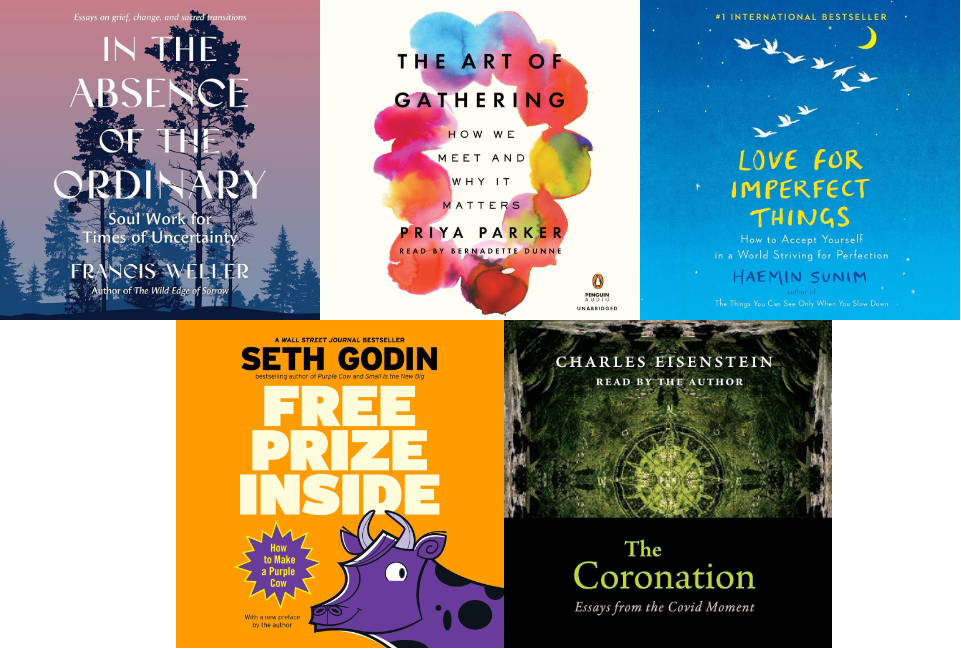
Francis Weller’s In the Absence of the Ordinary was gorgeous and lucid. This is a series of essays on “soul work” which, for Weller, includes things like “slow trauma” (developmental and complex) and the climate crisis.
Weller achieves a balance I sometimes strive for in my writing. No toxic positivity, but no wallowing either. Awake, aware, attuned (as possible). Honoring joy and the terrifying times we live in.
Except Weller probably wouldn’t say “terrifying times.” He might call it “threshold time.” In such times, he writes (my emphasis)
We are being called to embody courage and humility. Every one of us will be affected by the changes wrought by this difficult visitation. […] Never think that you have nothing to contribute to the shaping of our future. You are needed. You are necessary. It is time to become immense.
The Art of Gathering was useful and mildly triggering. How freaking cool this is how Priya Parker was spending the 2010s. Jealous. Haemin Sunim’s Love for Imperfect Things was gentle and kind. Seth Godin cracked the code on how marketing can be an empathy tool and Free Prize Inside was no exception.
Did you read any cool books last month?
Charles Eisenstein juxtaposes incredible topics together in compelling ways with beautiful language. The Coronation covered how COVID-19 would herald in a new and different time. It would have been a moving read a few years ago.
But here we are, looking at the calendar for March of 2026.
March Calendar
I offer a no-questions-asked discount of 25% off for both paid events: QHearts40
These offerings are practice-based explorations of the same question: how do you stay present when things are uncertain or conflict-riddled?
⚓ The Harbor: Coming home - March 8
A gathering designed to ground and name what arises.
Attunement is the foundation for everything else: conversation, presence, connection.
This month’s Harbor is a one-hour sit and share for Light Hive community members. We’ll move through a body scan, into dialogic practice around what’s arising, and close with a full group harvest.
March 8, 4-5:00 PM PT
The generosity of my paid subscribers makes this offering possible.
⚓ Sign up here!
👊 Fight Club: When to push, when to pause - March 15
Movements collapse not from external pressure but from internal conflict.
March’s Fight Club is a two-hour workshop for activists, organizers, and justice workers — people in the work, whether for six days or six years. We’ll practice what most conflict trainings skip: the part where you pause to see what this moment actually needs. Maybe it’s immediate action. Maybe it’s a clarifying question.
We'll open with a short meditation, move through a three-lens framework — an embodied check-in, a reality check, and a goal and strategy check — and use it in structured role-play with facilitated debrief. Come prepared to engage.
March 15, 3-5:00 PM PT
Base price: $20
Paid subscribers join free. The codes are in the paid chat, or you can DM or email for them.
👊 Sign up here!
🏕️ Creative Coalition: Sleepaway - March 22
Defeat the collective trauma monster as a camp counselor.
Imagine a sleepaway camp where the counselors know what they’re really protecting the kids from: the thing underneath. The weight that followed everyone here from the outside world.
Jay Dragon’s Sleepaway is an ENNIE Award-winning game about collective trauma and community care. Characters and places change based on interaction. If the Strangeness at the edges of camp makes itself known, you’ll build something together to meet it.
The Creative Coalition brings meditation practice off the cushion and into imaginative group play. There will be a meditation with intention-setting at the opening and debrief at the end.
As a camp counselor, your welcome packet will include character options and a few questions to help us build the world together before March 22.
March 22, 12-5:00 PM PT
Duration dependent upon number of players, but please prepare to be present during the allotted time.
There will be short screen breaks and reminders to stay embodied throughout.
Limit 5
Base price: $120
Paid subscribers join for 75% off ($30). The codes are in the paid chat, or you can DM or email for them.
One full scholarship is available. Please email or DM with what interests you about this game or experience.
***If you sign up before March 8, I’ll sign, seal, deliver a welcome letter to the camp counselor crew! (US only)***
🏕️ Sign up here!
Thank you for reading to the bottom. If my writing resonates with you, please consider a paid subscription. $8/month ($80/year) grants full archive access, the paid chat, and discounts on offerings.
mis-attunement ~ the incongruence within me, the incongruence with how i am who i am, the feeling there is no place for me… looking forward to considerations presented next month…
🙏🏼